
ATP7B-maintained copper stores in myeloid progenitors are required for functional maturation of neutrophils
Click to view the full article on the journal website.
Published in Cell Reports, Cell Press, 2026
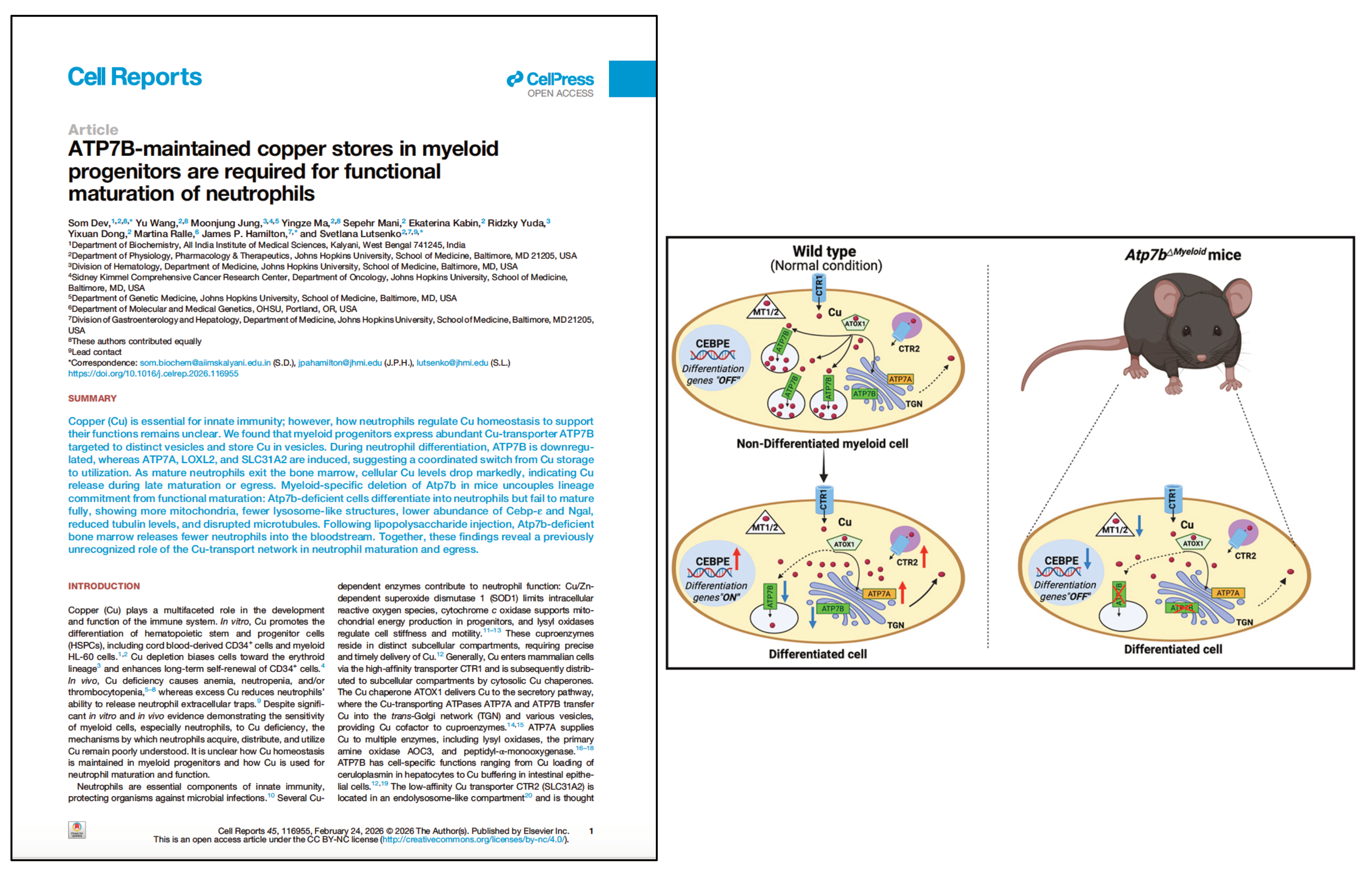
Abstract Copper (Cu) is essential for innate immunity; however, how neutrophils regulate Cu homeostasis to support their functions remains unclear. We found that myeloid progenitors express abundant Cu-transporter ATP7B targeted to distinct vesicles and store Cu in vesicles. During neutrophil differentiation, ATP7B is downregulated, whereas ATP7A, LOXL2, and SLC31A2 are induced, suggesting a coordinated switch from Cu storage to utilization. As mature neutrophils exit the bone marrow, cellular Cu levels drop markedly, indicating Cu release during late maturation or egress. Myeloid-specific deletion of Atp7b in mice uncouples lineage commitment from functional maturation: Atp7b-deficient cells differentiate into neutrophils but fail to mature fully, showing more mitochondria, fewer lysosome-like structures, lower abundance of Cebp-ε and Ngal, reduced tubulin levels, and disrupted microtubules. Following lipopolysaccharide injection, Atp7b-deficient bone marrow releases fewer neutrophils into the bloodstream. Together, these findings reveal a previously unrecognized role of the Cu-transport network in neutrophil maturation and egress
Keywords
Neutrophils; Myelopoiesis; ATP7B; Copper; Maturation
Recommended citation:
Download Paper