
Chronic alcohol consumption drives inflammaging and transposon derepression in hematopoietic stem and progenitor cells
Published:
Authors : Ridzky A. A. Yuda, Habin Bea, Valerie Kellett, Jungwoo Kim, Fan Yang, Haruna B. Choijilsuren, Yejie Park, Yaojie Fu, Zewen Ha, Juhye Choi, Li Z. Luo, Zhaoli Sun, Bin Gao, Sangmoo Jeong, Linda M. S. Resar, Moonjung Jung
excerpt: “Alcohol and aging effects on blood stem cells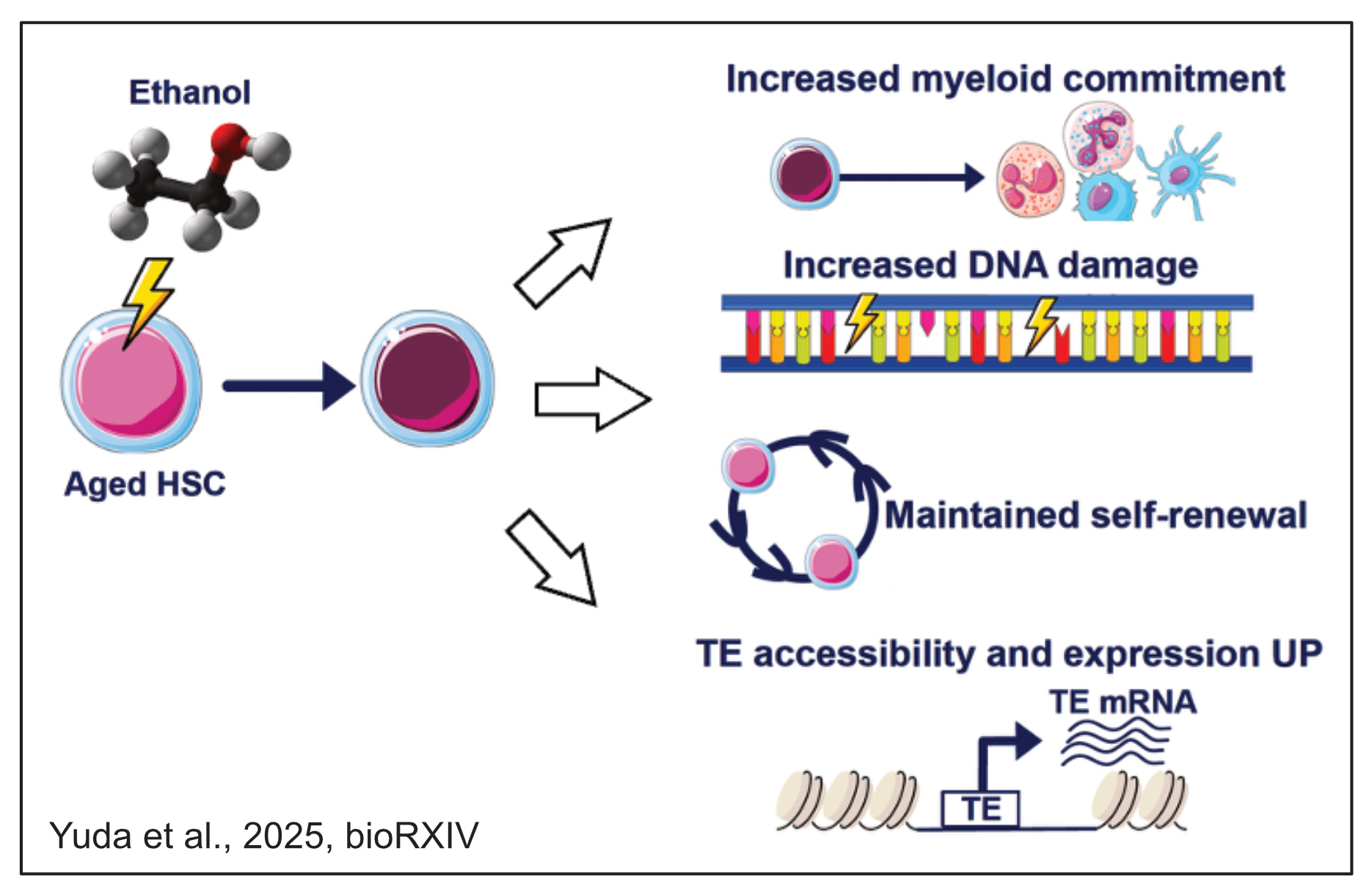 ” collection: portfolio —
Abstract
Chronic alcohol use causes pancytopenia and diminished immune responses against pathogens. However, it remains unclear whether chronic alcohol consumption directly induces inflammation in human hematopoietic stem progenitor cells (HSPCs), and if aging modifies the impact of chronic alcohol consumption in HSPCs. To examine how chronic alcohol use affects HSPCs, we performed single-cell RNA-seq in human and murine HSPCs and single-cell ATAC-seq in aged murine HSPCs following alcohol exposure. In xenotransplanted human HSPCs, chronic alcohol feeding resulted in a significant myeloid bias, heightened inflammation, double-stranded RNA (dsRNA) sensor upregulation, and type 1 interferon responses. In the native murine bone marrow, chronic alcohol exposure primed HSPCs to differentiate into myeloid cells and to exhibit heightened inflammation, DNA damage, and epigenetic reactivation of transposable elements (TEs) in an age-dependent manner. Alcohol-exposed aged long-term hematopoietic stem cells (LT-HSCs) displayed increased chromatin accessibility at TE-containing loci correlated with aberrant TE transcription. This transposon derepression was associated with the accumulation of dsRNAs in aged bone marrow cells, and activation of innate immune pathways, perpetuating HSC inflammaging. Furthermore, old mice showed two epigenomically distinct LT-HSC clusters, LT-HSC1 and LT-HSC2, in which the LT-HSC2 cluster expanded in response to chronic alcohol drinking and resembled inflammatory HSCs. Notably, secondary transplantation revealed unperturbed long-term self-renewal capacity in both human and murine HSCs, suggesting that HSC function may recover following alcohol cessation. Our data illuminate potential interactions between alcohol and aging that can reinforce inflammaging and epigenetic dysregulation in HSPCs.
Keypoints: Chronic alcohol consumption triggers age-dependent myeloid bias and inflammation in HSPCs without impairing self-renewalChronic alcohol consumption alters epigenome, driving heightened transposon upregulation in aged HSPCs.
The manuscript can be found here